
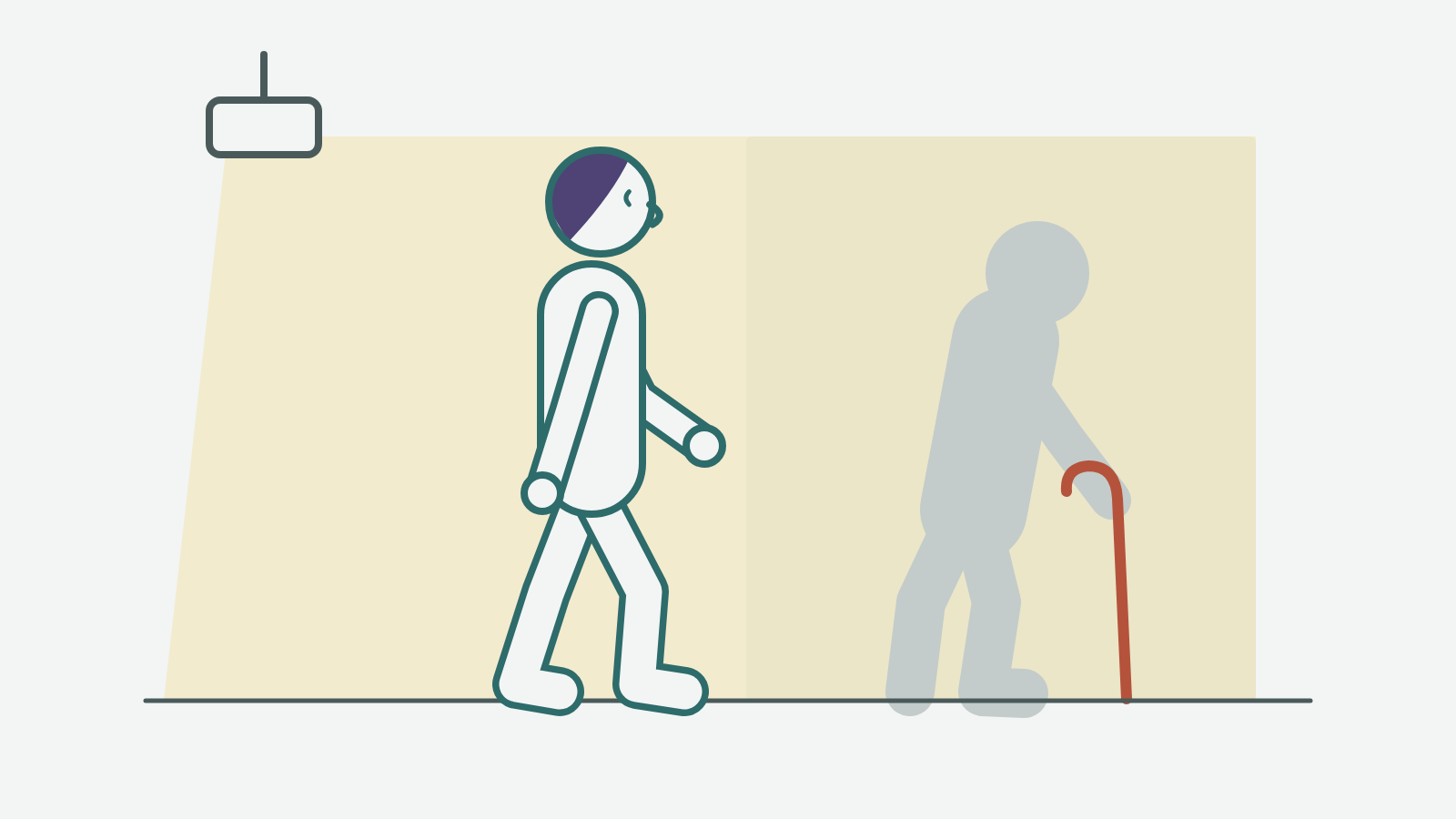
There is an unwritten rulebook for being disabled, and most of us learn it without being taught or even thinking about its rules. Pluto Rennie, writing in Salient this May, puts it this way: disability is supposed to be “obvious, stable, and easy to verify.”1 Rennie was accused of faking their disability after someone saw them walking without a cane on a good day. Anyone with a condition that comes and goes, or that gets worse slowly enough to be doubted, knows the feeling. It’s one reason why I’ve usually avoided using my cane, too.
Disability is not a physical or mental defect but a cultural and minority identity.
Charcot-Marie-Tooth disease is that kind of condition for many people who have it or a related neuropathy. It is progressive, but it rarely progresses in a straight line. It is visible on some days, on certain terrain, and in some shoes — but change one variable and it becomes invisible, or less visible and easier to hide. Fatigue and pain add to the hidden struggle, and neither shows up in a photo. So people with CMT get asked, quietly, to perform their disability correctly: to look as disabled as we say we are, and no more — or to hide it all as much as possible and then take the blame when the mask slips.
The literary scholar Tobin Siebers named this problem almost twenty years before Rennie described it, and his work is worth knowing about, for anyone who lives with something like CMT, whose effects can be subtle, variable, and progressive but not in static or linear ways.
Who Tobin Siebers Was
Siebers (1953–2015) taught English and art and design at the University of Michigan, where he co-chaired the university’s Initiative on Disability Studies.2 He had polio at two and lived with its after-effects all his life, which he wrote about in the essay “My Withered Limb.” His books Disability Theory (2008) and Disability Aesthetics (2010) helped define the field of disability studies. His starting point was blunt: disability, he wrote, is “not a physical or mental defect but a cultural and minority identity.”3
Passing and Masquerade
Most writing about stigma talks about “passing” — the art of hiding a disability so you can be treated as non-disabled. Siebers noticed there’s an opposite move as well. In “Disability as Masquerade” (2004), he described exaggerating his own limp in airports, because staff often refused to believe in his disability unless it was backed by something as visible as a wheelchair.4 He called this “masquerade” — performing disability more legibly than it is felt, so that other people will accept it as real.
Siebers knew the cost of passing from the inside. In “My Withered Limb,” he writes that years of “overexertion and bravado” had worn down his muscles and joints, and that he had always dreaded using a cane. When he finally tried one, the pain in his back eased, and only then did he notice it: “I had not realized that I was previously in pain.”5
Masquerade is not lying. It is people coping with pain and physical loss by norming it and “forgetting” its handicapping effects. I know from experience this can help avoid stigam and social disadvantages, but it can also put you in a physically and psychologically precarious and dangerous place.
Masquerading is a response to a world that only recognizes one picture of disability. Siebers also saw it as a way of taking some control over the stereotypes by using them to tell different stories about oneself.6 Rennie, writing from inside the experience, describes the cost: the constant monitoring of whether you seem too dramatic or not believable enough.
I’ve felt this strongly in situations like a crowded train or bus where there’s a clear expectation I should leave open seats to anyone obviously older or with a visible disability. I’ve heard from others with CMT in the UK that they have been verbally attacked, and even physically accosted, by strangers over their Blue Badge parking permits.
Bodies That Don’t Hold Still
Siebers also pushed back against a tidy version of the social model of disability, the idea that disability comes entirely from barriers in the environment that can be fixed or mitigated by accessible design. Ramps and text captions matter, but some things, like chronic pain, come from the body itself.7 Siebers’ alternative was “complex embodiment,” which treats the body and the meanings society gives it as shaping each other. Neither the doctor’s chart nor the social critique tells the whole story.
Better sidewalks and good braces help weak ankles, but no redesign of the world makes CMT fatigue disappear.
That fits CMT well. Weak legs and ankles or twisted feet that don’t make much direct contact with the ground are made worse by uneven sidewalks and better by good braces. Fatigue is made worse by jobs and schools built for bodies that don’t tire, but no redesign makes it vanish. And the body changes over years, so what someone could do last year is no guide to what they can do now. Rennie’s line fits CMT: our bodies “are not coherent.”
Pain is not a side issue in CMT. In a 2014 study of 176 children with CMT, 80 percent reported some pain, and more pain went with worse quality of life. The pain did not rise with the severity of nerve damage, which suggests that measuring the neuropathy alone won’t explain it.8
The Ideology of Ability
Behind the demand for a consistent, verifiable disability, Siebers saw what he called the ideology of ability, “at its simplest the preference for able-bodiedness.”9 It makes disability something to be overcome, cured, or explained, and it makes others’ suspicion feel reasonable to them. Rennie adds a sharper point: suffering is welcome when it can be turned into funding and a reassuring story, but objecting to that story reads as ingratitude.
Suffering is welcome when it can be turned into funding and a reassuring story, but objecting to that story reads as ingratitude.
Rennie learned this at an early age. As a teenager, Rennie objected when their medical history was shared publicly to raise money for a hospital, and a family member said they were being ridiculous.10
The late Australian comedian and activist Stella Young made a related point in a 2014 TEDx talk, calling the use of disabled people to make others feel better “inspiration porn.”11 The pity appeal and the inspiration appeal are two sides of the same coin. Both turn a disabled person into material for someone else’s feelings.
Stories in the CMT World
Patient stories are how charities raise money, how companies recruit for trials, and how blogs like this one find readers. Whose story is it, and who gets to tell it?
Rare-disease fundraising leans hard on hope, often on children, and on the promise of a cure. Real hope is not something that can be bought, and it’s not synonymous with the cessation of symptoms and pain. Those are good, if incomplete, goals that science and medicine struggle to measure and address, which they don’t do for free. Research requires money. But the stories that circulate for fundraising are a narrow slice of CMT life: the newly diagnosed child, the family raising funds, the trial that might change everything. The adult managing pain for decades, the person whose CMT is progressing and who has no trial to join, the person who doesn’t want to be anyone’s inspiration, never make the brochure. Ask why.
I’ve looked at how the CMTA does this in its own fundraising, in Barbies and Warriors: How the CMTA Sells CMT.
Part of the trouble is that chronic illness doesn’t fit the shape these stories need. As Naomi Morris put it in a 2021 essay for Wellcome Collection, “chronic illness resists having a beginning, middle and end.” CMT has no cure yet, and most of it is lived in the middle.12
A few things would help make the marketing more ethical, humane, and grounded in the lived reality of the disease for most people who have it:
- listen more.
- ask before telling.
- let people tell, change, and withdraw their stories.
- tell stories that don’t resolve nicely or at all.
- pay attention to who isn’t in the picture.
None of this means telling fewer stories — it should mean telling more! And it means not requiring disabled people to suffer usefully for others’ extractive purposes, however good the intentions.
Being Hard to Read
“The Perfect Cripple: A User Guide to Being Palatable” ends with Rennie suggesting that refusing to be coherent, palatable, and reassuring may be the most honest response to the suffering and struggle that comes with disease and disability. Siebers surely would have agreed, while pointing out that most disabled people move between passing, masquerade, and plain honesty depending on who is watching and what is at stake. Neither Rennie nor Sibers asks disabled people to perform less. They ask everyone else to need less performance.
How much performance have you been demanding, consciously or unconsciously, of others without considering their well-being in the places that are invisible or easy to ignore, that they may be masking?
Notes
- Rennie, “The Perfect Cripple.” ↩︎
- University Record, “Remembering Tobin Siebers”; Siebers, “My Withered Limb.” ↩︎
- Siebers, Disability Theory, 4. ↩︎
- Siebers, “Disability as Masquerade,” 1. ↩︎
- Siebers, “My Withered Limb.” ↩︎
- Siebers, “Disability as Masquerade,” 19–20. ↩︎
- Siebers, Disability Theory, 25. ↩︎
- Ramchandren et al., “Effect of Pain in Pediatric Inherited Neuropathies.” The 80 percent is by the children’s own report; by parents’ report it was 85 percent. ↩︎
- Siebers, Disability Theory, 8. ↩︎
- Rennie, “The Perfect Cripple.” ↩︎
- Young, “I’m Not Your Inspiration, Thank You Very Much.” ↩︎
- Morris, “Chronic Illness and the Pressure to Get Well.” ↩︎
Bibliography
- Morris, Naomi. “Chronic Illness and the Pressure to Get Well.” Wellcome Collection. November 23, 2021. https://wellcomecollection.org/stories/chronic-illness-and-the-pressure-to-get-well.
- Ramchandren, Sindhu, Mamta Jaiswal, Eva Feldman, and Michael Shy. “Effect of Pain in Pediatric Inherited Neuropathies.” Neurology 82, no. 9 (2014): 793–797. https://doi.org/10.1212/WNL.0000000000000173.
- University Record. “Remembering Tobin Siebers, English Professor, Disability Studies Advocate.” January 30, 2015. https://record.umich.edu/?p=36083.
- Rennie, Pluto. “The Perfect Cripple: A User Guide to Being Palatable.” Salient, May 10, 2026. https://www.salient.org.nz/post/the-perfect-cripple-a-user-guide-to-being-palatable.
- Siebers, Tobin. Disability Aesthetics. Ann Arbor: University of Michigan Press, 2010.
- Siebers, Tobin. “Disability as Masquerade.” Literature and Medicine 23, no. 1 (2004): 1–22. https://muse.jhu.edu/article/170316.
- Siebers, Tobin. Disability Theory. Ann Arbor: University of Michigan Press, 2008.
- Siebers, Tobin. “My Withered Limb.” Michigan Quarterly Review, 1998; reprinted online February 2021. https://sites.lsa.umich.edu/mqr/2021/02/my-withered-limb/.
- Young, Stella. “I’m Not Your Inspiration, Thank You Very Much.” Talk at TEDxSydney, April 2014. https://www.ted.com/talks/stella_young_i_m_not_your_inspiration_thank_you_very_much.
Leave a Reply