
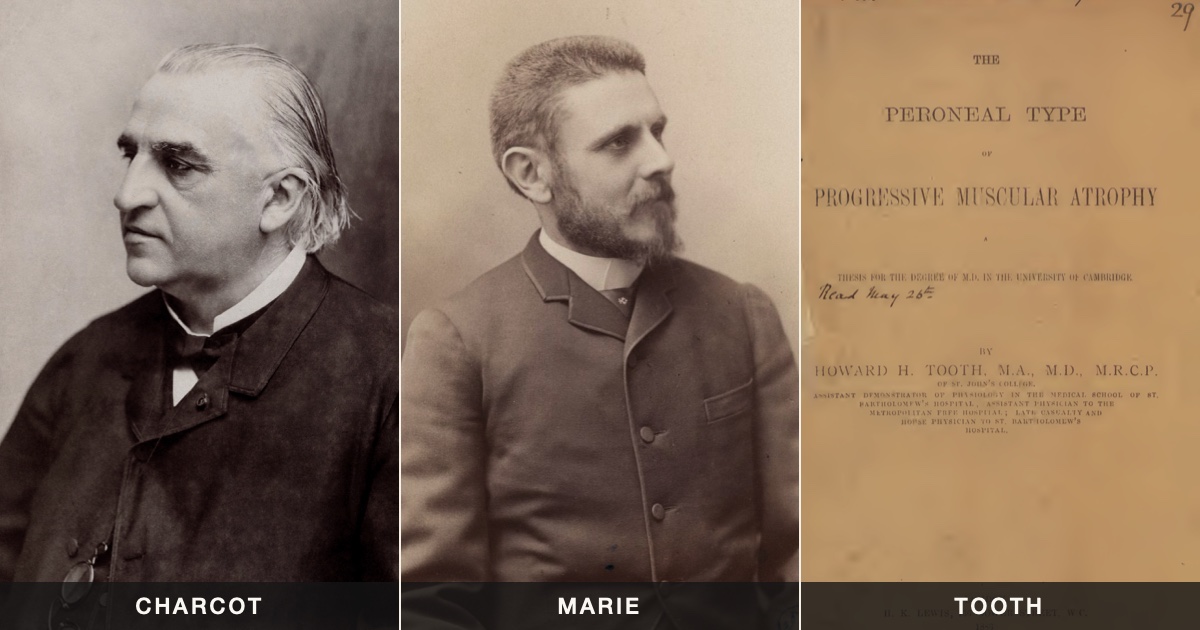
If you’ve tried to work out which “type” of CMT you have, or what a type name on a lab report means, you’ve probably found that the names don’t line up. One source says CMT2A, another says MFN2-related neuropathy. A paper calls something CMT1J; a later paper describes a family with the same gene whose nerve conduction is intermediate. Charities, journals, and genetic labs each use their own mix of old and new labels.
This taxonomic mess isn’t anyone’s fault, exactly. It’s what happens when a naming system built for one way of diagnosing a disease survives as a completely different one is built around it. This post is my attempt to explain how we got here, and how to find information you can actually rely on.
This post is also a companion to the Open CMT Gene Table, which I maintain. It’s an open, downloadable list of the genes linked to CMT and related neuropathies, with the ClinGen evidence rating, the Mondo disease ID, and the old lettered subtype names side by side. If you want to look up one gene, start there. If you want to know why the names don’t agree, read on.
The Original Split: How Fast the Signal Travels
The first big division in CMT came from nerve conduction studies. GeneReviews, the most widely used clinical reference, still sets out the bands. In CMT1 (demyelinating) the motor nerve conduction velocity is below 35 metres per second. In CMT2 (axonal) it’s above 45. Dominant intermediate CMT sits between 35 and 45, and values can straddle those ranges even within one family.1 Truth be told, research now shows most CMT types involve losses to both the axon and myelin sheath in nerves.
My own shorthand from years ago went like this: in CMT1 the signal is slowed because the myelin insulating the nerve is damaged; in CMT2 the speed is closer to normal but the signal (amplitude) is weak, which shows up as a reduced compound muscle action potential (CMAP), because axons are being lost. That’s roughly accurate, but it’s a simplification. As I argued in All types of CMT are “Axonal”, disability in CMT1A tracks axon loss rather than slowing.2 So, the label that describes the nerve test doesn’t describe what actually disables people.
Then the Alphabet Ran Out
Once genes started to be found, each new one got a letter. CMT1A is the PMP22 duplication, CMT1B is MPZ, CMT2A2 is MFN2, and so on. Recessive forms became CMT4 and X-linked forms became CMTX. GeneReviews now says more than 80 genes are associated with CMT, a figure it takes from a 2016 review, and it says the PMP22 duplication accounts for as much as half of all cases. Some letters are now very far down the alphabet.
The letters also hide history. “CMT3” isn’t a modern group of genes at all. It’s an older name for Dejerine-Sottas disease, a severe early-onset neuropathy also called HMSN III, which can be caused by several genes, including PMP22 and MPZ.3 I tripped over this myself: I once filed a note about a new gene under “CMT3” when the gene had nothing to do with Dejerine-Sottas. That gene, SARS1, encodes the enzyme seryl-tRNA synthetase (SerRS); variants in it were reported to cause dominant CMT in three unrelated families.4
Some examples of how messy it gets:
- CMT1J is the label for dominant CMT caused by ITPR3 variants, first described as demyelinating with secondary axonal features.5 A later family with an ITPR3 variant had adult-onset intermediate CMT.6 Same gene, different box.
- HINT1 neuropathy is usually just called by its gene name. It’s a recessive axonal neuropathy in which about 80% of patients have neuromyotonia, a muscle stiffness or delayed relaxation that can help point to the diagnosis.7 GeneReviews lists HINT1 among the eight genes most often involved in CMT, so “rare” is relative.
- SORD causes a recessive axonal or intermediate neuropathy. It’s also on GeneReviews’ list of the eight most common genes, yet people still argue about whether to call it CMT, “CMT-SORD” or sorbitol dehydrogenase deficiency. I made my case in The “First Treatable CMT Disease” is Neither CMT Nor a Disease. Technically, it is a genetically induced enzyme deficiency that creates a disorder that should be treatable, but that is a topic for another time.
- Motor-only and sensory-only forms blur the edges. GeneReviews notes that distal hereditary motor neuropathy shares genes with motor CMT, and a UCL review treats CMT, hereditary motor neuropathy, and hereditary sensory neuropathy together as one group.8
The Proposed Fix: Name the Gene
In 2015 a group of neurologists, most of them French, proposed replacing the letters with a description: inheritance, type of neuropathy, and gene.9 CMT4A, for example, would become AR-CMTDe-GDAP1 (autosomal recessive, demyelinating CMT, caused by GDAP1). In 2018 they surveyed CMT specialists. Of the 107 who answered, 65% thought changes were needed and that the proposals improved on the old system.10 GeneReviews now explains the proposal alongside the old names.
I think gene-based naming will win in the clinic and the lab, slowly. It’s longer and uglier, but it tells you what you actually need to know: how a disease is inherited, what’s happening in the nerve, and which gene to look up for the root cause. The old letters and names will hang on wherever brands and fundraising have been built around them.
Gene First: ClinGen, Mondo and “Gene-Related” Names
The 2018 proposal wasn’t the only push toward gene-first names. In 2021 a large group of clinical geneticists proposed that every single-gene disorder be named as a pair: the gene plus a description of the condition, written “GENE-related phenotype,” as in “CFTR-related cystic fibrosis”.11 Applied to CMT, that creates names like “MFN2-related CMT.” GeneReviews has been moving in the same direction in its gene chapters. The MFN2 chapter is titled “MFN2 Hereditary Motor and Sensory Neuropathy,” shortened to MFN2-HMSN,12 and the GJB1 chapter is “GJB1 Disorders,” with CMT1X kept in the subtitle.13
ClinGen, the Clinical Genome Resource, rates how strong the evidence is that a gene causes a disease. Before it can do that, a curation panel has to decide what “the disease” is. ClinGen’s rules for this “lumping and splitting” weigh four things: what has been claimed in the literature, the molecular mechanism, how much the condition varies between families, and the inheritance pattern. If there’s no clear difference in mechanism between two named conditions, that counts as a strong reason to lump them, and they can be split again later if the evidence changes.14 ClinGen then formed a Disease Naming Advisory Committee with representatives of Mondo and OMIM, which published its first guidance on disease names in 2024.15
You can see the results in ClinGen’s CMT curations. Of the 72 curations by its Charcot-Marie-Tooth Disease Gene Curation Expert Panel, 15 are filed under the plain umbrella term “Charcot-Marie-Tooth disease,” with no letter at all. GDAP1, HINT1, MPZ and SORD are among them. Others keep the old labels: MFN2 is curated as “Charcot-Marie-Tooth disease type 2A2,” and ITPR3 as “Charcot-Marie-Tooth disease, demyelinating, type 1J”.16 Lumping can also cross specialties. ClinGen’s hearing loss panel curated PRPS1 against a single condition, “PRPS1 deficiency disorder,” which Mondo describes as covering what had been reported as Arts syndrome, CMTX5 and non-syndromic hearing loss.
Mondo, the Mondo Disease Ontology, is what holds these names together. It merges disease terms from OMIM, Orphanet, MeSH and other sources, and gives each disease concept a stable ID. ClinGen uses those IDs for its curations.17 Mondo doesn’t throw old names away. It keeps them as synonyms, so the entry ClinGen uses for MFN2 also lists CMT2A2, CMT2A2A and HMSN IIA2. Some Mondo names are already hybrids, such as “MME-related autosomal dominant Charcot Marie Tooth disease type 2.” This is what lets the gene table put a ClinGen label, a Mondo ID, and the old letters on the same row.
The French Documents: A Care Protocol and a Gene List
You may see references to French “recommendations” or a French “consensus” on CMT. There are two separate documents, and neither proposes new names.
The first is a national diagnostic and care protocol (protocole national de diagnostic et de soins, or PNDS) for CMT. It’s dated March 2020 and was posted on the website of France’s Haute Autorité de Santé (HAS) in April 2020. It was produced under the coordinating reference centre for rare neuromuscular diseases and ALS at La Timone hospital in Marseille. HAS says it did not take part in writing it and has not validated it. The PNDS keeps the familiar framework (CMT1, CMT2, dominant intermediate, CMT4 and CMTX) and counts more than 80 genes. It also says plainly that classifying CMT by gene is as complicated as classifying it by nerve conduction. Its testing sequence matches GeneReviews: PMP22 first, then a gene panel, then exome or genome sequencing, decided jointly by the clinician and the geneticist.18
The second is the 2022 “National French Consensus on Gene List” from the genetic diagnosis section of FILNEMUS, France’s national network for rare neuromuscular diseases. FILNEMUS coordinates the seven French laboratories that use next-generation sequencing for inherited neuropathies.19 It’s a gene list, not a naming scheme. The labs agreed on a single panel of 127 genes: 81 for CMT, 26 for distal hereditary motor neuropathy and 20 for hereditary sensory and autonomic neuropathy, with some genes in more than one group. They used ClinGen’s rating where one existed. Otherwise they called a gene “definitive” if it had at least two clinical reports plus functional evidence, and “limited” if not. That gave 93 definitive and 34 limited genes. They used one panel for all three groups because so many genes cross the lines, and they noted that two genes, KIF1B and MED25, had been disputed.
The French naming proposal is the one described above, from Jean-Michel Vallat, Stéphane Mathis, Laurent Magy and colleagues.20 The 2022 gene-list paper doesn’t adopt it. Instead, it says the working group aims to classify all “gene-related diseases” using ClinGen’s framework.
When There’s No Name at All
All of this assumes you have a genetic diagnosis. Many people don’t. In the Inherited Neuropathy Consortium’s large natural history study, 60.4% of 1,652 patients had a genetic diagnosis; five subtypes accounted for 89.2% of those.21 The odds are worse for the axonal and intermediate forms. In 2025 the CMTA said up to half of people with those forms lack genetic confirmation, and it is funding long-read sequencing to look for the missing genes.22
I’m one of them. I have CMT2-type symptoms, no match for known CMT genes, and no family members with similar symptoms. That’s the “unidentified type 2” box, which isn’t really a type at all. It’s a waiting room.
Living without a named type is hard in two ways. The first is uncertainty. Without a gene, there’s no natural history to look up, so I can’t know what the disease will do next, and that brings real fear about how it will progress. The second is social. With my feet and legs covered, I don’t look like I have a disease, let alone a crippling one, and I have no medicalized name to offer as an explanation. That makes for awkwardness, confusion and some degree of shame.
How Testing Works Now
GeneReviews recommends three steps. First, test for PMP22 duplication or deletion in everyone. Next, a multigene panel that includes the most common genes. If that comes back empty, exome or genome sequencing.23 Whole-genome sequencing can find variants that panels and exomes miss, and the UCL group has proposed how to fit it into CMT diagnosis.24 This is more careful than the “go straight to exome sequencing” impression I gave in New Genetic Diagnostics for CMT, which needs updating. For the wider question of when it isn’t CMT at all, see Diagnostic Pathways for Idiopathic Neuropathy and CIDP and CMT.
If you’re in Canada, ask your neurologist about a referral to medical genetics or a neuromuscular clinic, and ask what testing has been done, what’s covered and what was left out. A “negative” panel only means negative for the genes on that panel.
Where the Gene Lists Disagree
If you compare the major gene lists, you’ll find they don’t agree on how many genes cause CMT, or which ones. As of October 2026:
- ClinGen’s CMT expert panel has 72 curations covering 70 genes, including some sensory and motor neuropathy genes.25
- GeneReviews says more than 80 genes are associated with CMT, a figure it takes from a 2016 review. Its main CMT table “presents information on 74” of them, and sensory neuropathy genes are in a separate table.26
- Genomics England’s PanelApp “Hereditary neuropathy” panel (version 1.513, July 2026) lists 288 genes, 159 of them rated green, its highest evidence level.27
- The French consensus lists 127 genes across CMT, distal motor and sensory neuropathies.28
- The GeneTable of Neuromuscular Disorders (musclegenetable.fr), maintained by Gisèle Bonne, François Rivier and Dalil Hamroun, catalogues 713 genes across all neuromuscular disorders, with a separate group for hereditary motor and sensory neuropathies.29
- Alan Pestronk‘s site at Washington University’s Neuromuscular Disease Center includes a dense HMSN/CMT catalogue — dense in the best way — it’s really amazing! Pestronk has linked genes to their clinical presentation in specific patients, with references to the associated literature. Last updated in September 2026, it carries the lettered subtypes well past CMT2Z, to CMT2HH and beyond.30
The differences show up gene by gene:
- NDRG1 (CMT4D), LMNA (CMT2B1), PRPS1 (CMTX5) and AIFM1 (CMTX4, Cowchock syndrome) are in GeneReviews’ CMT table, rated green on PanelApp, and listed in the GeneTable and on the Washington University page. ClinGen’s CMT panel hasn’t curated them. Other ClinGen panels have: PRPS1 and AIFM1 through hearing loss, and LMNA for heart and fat-tissue disorders, but not for CMT.
- DHTKD1 (CMT2Q) is in GeneReviews, the GeneTable and the Washington University page. PanelApp rates it red, and ClinGen has curated it only for a metabolic disorder, 2-aminoadipic 2-oxoadipic aciduria.
- KIF1B (CMT2A1) is still in GeneReviews’ table and the GeneTable as CMT2A1. ClinGen rates its link to CMT “Limited,” PanelApp rates it red, the Washington University page marks it with a question mark, and the French consensus calls it disputed.
- MED25 (CMT2B2) is rated “Disputed” by ClinGen and red by PanelApp. The Washington University page still lists it as a cause of recessive CMT2B. GeneReviews cites a 2018 paper that attributes CMT2B2 to a different gene, PNKP.
- COQ7 is rated “Strong” by ClinGen for distal hereditary motor neuropathy. It isn’t in the GeneReviews overview or on PanelApp’s neuropathy panel, and the GeneTable files it under motor neuron and other disorders rather than hereditary motor and sensory neuropathies.
- ITPR3 (CMT1J) is rated “Definitive” by ClinGen and is in GeneReviews, the GeneTable and on the Washington University page, but it isn’t on PanelApp’s neuropathy panel as of version 1.513.
Even the gene symbols differ. The tRNA synthetase genes were renamed (GARS became GARS1, for example), but PanelApp’s neuropathy panel still lists GARS, AARS, YARS and WARS, and GeneReviews’ CMT table uses WARS where ClinGen uses WARS1. In 2026 a group of researchers, responding to requests from patients, families and advocacy groups, asked the field to use a single naming system for these genes.31
None of these lists is simply wrong. They do different jobs. ClinGen grades the evidence for one gene–disease pair at a time, so its list grows only as fast as its panel finishes curations. PanelApp’s neuropathy panel casts a wide net for diagnostic testing and includes multisystem conditions where neuropathy is one feature among many, such as TTR, POLG and SMN1. GeneReviews and the GeneTable are reference catalogues, and the Washington University page records nearly everything that has been reported. They also differ in whether sensory and motor-only neuropathies count, how much evidence a gene needs, and how often they’re updated. The Open CMT Gene Table follows ClinGen’s CMT panel, so genes like NDRG1 are missing from it for now. Their absence doesn’t mean they’ve been ruled out.
What This Means for You
This isn’t medical advice. But if you have a genetic report, or are waiting for one, a few things may make it easier to read.
- The gene is the anchor. A report might say “MFN2-related neuropathy,” “CMT2A2” or “HMSN type IIA.” Find the gene symbol and look that up. The old letters usually survive as synonyms in Mondo and OMIM, so you can get from one name to the other.
- Check for renamed genes. GARS and GARS1 are the same gene, and so are SEPT9 and SEPTIN9. Older papers and some panels still use the old symbols.
- A gene’s rating isn’t a verdict on your variant. ClinGen’s ratings (Definitive, Strong, Moderate, Limited, Disputed and so on) describe the evidence that a gene causes a disease. Whether a particular variant causes it is judged with a separate framework.32
- Know what was tested. GeneReviews notes that some panels may not include all the genes in its table.33 Comparing your lab’s gene list with the gene table is one way to see what was left out.
- Take your questions to a genetic counsellor or neuromuscular clinic. They can tell you what a name on your report means for you.
The Open CMT Gene Table puts each gene’s ClinGen rating, Mondo ID, OMIM phenotype IDs and historical subtype names on one row, with links to the source curations. The data is also on GitHub. It isn’t a diagnostic tool, and it leaves out genes that ClinGen’s CMT panel hasn’t curated yet.
Where to Find Reliable Information
Because the names are a mess, it’s easy to get lost, and easy for confident-sounding sources to fill the gap. Here’s what I trust, and why.
- GeneReviews’ Charcot-Marie-Tooth Hereditary Neuropathy Overview: written for clinicians, but readable. It’s been revised regularly since 1998, most recently in November 2025, and it cites its sources.
- The NINDS Charcot-Marie-Tooth Disease page: a plain-language overview from the US National Institutes of Health, last reviewed in September 2026. (The old NINDS “fact sheet” address I bookmarked in 2020 has moved.) MedlinePlus Genetics is similar.
- OMIM and NCBI MedGen: technical catalogues of genes and conditions, useful for checking what a label like CMT1J officially refers to.
- Review articles by the major clinical research groups: for example, Mary Reilly’s group at UCL Queen Square34 and the Inherited Neuropathy Consortium. Michael Shy and Karen Krajewski’s Charcot-Marie-Tooth: A Guide for Patients and Families (2007) is written by clinicians who know CMT, but it predates most of the gene discoveries, so check anything genetic against a current source.
- Your own clinic: a neuromuscular specialist or genetic counsellor who has your test results will know more about your case than any website.
And some warning signs, whoever the author is:
- No date, or no sign the material has been updated since the last round of gene discoveries.
- Confident lists of “all the types” with no references to the papers that define them.
- Credentials that don’t match the claims. A long list of genes isn’t the same as clinical or research expertise.
- Self-published books and guides that haven’t been through peer review or editorial review by clinicians.
- Anything that ends by selling you a product, a test or a membership.
None of this means non-specialists can’t write useful things about CMT. I’m not a clinician, and you’re reading this. It means you should be able to see where a claim comes from and check it. Where you can’t, treat it as a lead, not an answer.
Update, October 27, 2026: The follow-up post, Who Decides What Counts as CMT?, looks at the conditions on CMT’s edges, who decides where they belong, and why “CMT” itself is on its way out in clinics and labs.
Notes
- Bird, “Charcot-Marie-Tooth Hereditary Neuropathy Overview.” ↩︎
- Krajewski et al., “Neurological Dysfunction and Axonal Degeneration.” ↩︎
- “Dejerine-Sottas Disease,” MedGen. ↩︎
- He et al., “Heterozygous Seryl-tRNA Synthetase 1 Variants.” ↩︎
- Rönkkö et al., “Dominant Mutations in ITPR3.” ↩︎
- Cabello-Murgui et al., “ITPR3-Associated Neuropathy.” ↩︎
- Peeters et al., “Axonal Neuropathy with Neuromyotonia.” ↩︎
- Pipis et al., “Next-Generation Sequencing in Charcot-Marie-Tooth Disease.” ↩︎
- Mathis et al., “Charcot-Marie-Tooth Diseases.” ↩︎
- Magy et al., “Updating the Classification.” ↩︎
- Biesecker et al., “Dyadic Approach.” ↩︎
- Züchner, “MFN2 Hereditary Motor and Sensory Neuropathy.” ↩︎
- Abrams, “GJB1 Disorders.” ↩︎
- Thaxton et al., “Lumping versus Splitting.” ↩︎
- Thaxton et al., “Implementation of a Dyadic Nomenclature.” ↩︎
- ClinGen, “Gene-Disease Validity Curations.” ↩︎
- Vasilevsky et al., “Mondo.” ↩︎
- Centre de Référence, Neuropathies héréditaires sensitivomotrices de Charcot-Marie-Tooth. ↩︎
- Benquey et al., “National French Consensus on Gene List.” ↩︎
- Mathis et al., “Charcot-Marie-Tooth Diseases.”; Magy et al., “Updating the Classification.” ↩︎
- Fridman et al., “CMT Subtypes and Disease Burden.” ↩︎
- “CMTA Invests $210K in Long-Read Sequencing.” ↩︎
- Bird, “Charcot-Marie-Tooth Hereditary Neuropathy Overview.” ↩︎
- Pipis et al., “Next-Generation Sequencing in Charcot-Marie-Tooth Disease.” ↩︎
- ClinGen, “Gene-Disease Validity Curations.” ↩︎
- Bird, “Charcot-Marie-Tooth Hereditary Neuropathy Overview.” ↩︎
- Genomics England, “Hereditary Neuropathy (Panel 85).” ↩︎
- Benquey et al., “National French Consensus on Gene List.” ↩︎
- Benarroch et al., “2026 Version of the Gene Table.” ↩︎
- Pestronk, “Hereditary Motor Sensory Neuropathies.” ↩︎
- Antonellis et al., “Call for Unified Use.” ↩︎
- Richards et al., “Standards and Guidelines.” ↩︎
- Bird, “Charcot-Marie-Tooth Hereditary Neuropathy Overview.” ↩︎
- Pipis et al., “Next-Generation Sequencing in Charcot-Marie-Tooth Disease.” ↩︎
Sources
- Abrams, Charles K. “GJB1 Disorders: Charcot-Marie-Tooth Neuropathy (CMT1X) and Central Nervous System Phenotypes.” GeneReviews. University of Washington, Seattle. Revised April 25, 2024. https://www.ncbi.nlm.nih.gov/books/NBK1374/.
- Antonellis, Anthony, Maximiliano Barrientos, Eva Bensasson, Teri DeClercq, Pablo Garrigós, Rachel Heilmann, Rita Horvath, et al. “A Call for Unified Use of Human Aminoacyl-tRNA Synthetase (ARS) Gene Nomenclature.” FEBS Letters 600, no. 16 (2026): 2211–18. https://doi.org/10.1002/1873-3468.70418.
- Benarroch, Louise, Gisèle Bonne, François Rivier, Vincent Procaccio, and Dalil Hamroun. “The 2026 Version of the Gene Table of Neuromuscular Disorders (Nuclear Genome).” Neuromuscular Disorders 58 (2026): 106303. https://doi.org/10.1016/j.nmd.2025.106303.
- Benquey, Thibaut, Emmanuelle Pion, Mireille Cossée, Martin Krahn, Tanya Stojkovic, Aurélien Perrin, Mathieu Cerino, et al. “A National French Consensus on Gene List for the Diagnosis of Charcot-Marie-Tooth Disease and Related Disorders Using Next-Generation Sequencing.” Genes 13, no. 2 (2022): 318. https://doi.org/10.3390/genes13020318.
- Biesecker, Leslie G., Margaret P. Adam, Fowzan S. Alkuraya, Anne R. Amemiya, Michael J. Bamshad, Anita E. Beck, James T. Bennett, et al. “A Dyadic Approach to the Delineation of Diagnostic Entities in Clinical Genomics.” American Journal of Human Genetics 108, no. 1 (2021): 8–15. https://doi.org/10.1016/j.ajhg.2020.11.013.
- Bird, Thomas D. “Charcot-Marie-Tooth Hereditary Neuropathy Overview.” GeneReviews. University of Washington, Seattle. Revised November 20, 2025. https://www.ncbi.nlm.nih.gov/books/NBK1358/.
- Cabello-Murgui, Javier, Jesús Jiménez-Jiménez, Juan J. Vílchez, Inmaculada Azorín, Pilar Martí-Martínez, Elvira Millet, Vincenzo Lupo, Teresa Sevilla, and Rafael Sivera. “ITPR3-Associated Neuropathy: Report of a Further Family with Adult Onset Intermediate Charcot-Marie-Tooth Disease.” European Journal of Neurology 31, no. 12 (2024): e16485. https://doi.org/10.1111/ene.16485.
- Centre de Référence coordinateur des Maladies Neuromusculaires rares et de la SLA, CHU La Timone, Marseille. Neuropathies héréditaires sensitivomotrices de Charcot-Marie-Tooth: Protocole national de diagnostic et de soins (PNDS). Haute Autorité de Santé, March 2020. https://www.has-sante.fr/jcms/p_3168018/fr/neuropathies-hereditaires-sensitivomotrice-de-charcot-marie-tooth.
- “Charcot-Marie-Tooth Disease.” National Institute of Neurological Disorders and Stroke. Last reviewed September 2, 2026. https://www.ninds.nih.gov/health-information/disorders/charcot-marie-tooth-disease.
- “Charcot-Marie-Tooth Disease.” MedlinePlus Genetics. National Library of Medicine. https://medlineplus.gov/genetics/condition/charcot-marie-tooth-disease/.
- Clinical Genome Resource (ClinGen). “Gene-Disease Validity Curations.” ClinGen Knowledge Base. Download file dated October 13, 2026. https://search.clinicalgenome.org/kb/gene-validity.
- “CMTA Invests $210K in Long-Read Sequencing to Find New Genes.” Charcot–Marie–Tooth Association, April 22, 2025. https://cmtausa.org/press-release/cmta-210k-long-read-gene-discovery/.
- “Dejerine-Sottas Disease.” MedGen. National Center for Biotechnology Information. https://www.ncbi.nlm.nih.gov/medgen/C0011195.
- Fridman, V., B. Bundy, M. M. Reilly, D. Pareyson, C. Bacon, J. Burns, J. Day, et al. “CMT Subtypes and Disease Burden in Patients Enrolled in the Inherited Neuropathies Consortium Natural History Study: A Cross-Sectional Analysis.” Journal of Neurology, Neurosurgery and Psychiatry 86, no. 8 (2015): 873–78. https://doi.org/10.1136/jnnp-2014-308826.
- Genomics England. “Hereditary Neuropathy (Panel 85), Version 1.513.” Genomics England PanelApp, July 27, 2026. https://panelapp.genomicsengland.co.uk/panels/85/.
- He, Jin, Xiao-Xuan Liu, Ming-Ming Ma, Jing-Jing Lin, Jun Fu, Yi-Kun Chen, Guo-Rong Xu, et al. “Heterozygous Seryl-tRNA Synthetase 1 Variants Cause Charcot-Marie-Tooth Disease.” Annals of Neurology 93, no. 2 (2023): 244–56. https://doi.org/10.1002/ana.26501.
- Knauss, Dan. “Open CMT Gene Table.” cmt.blog, 2026. https://github.com/dknauss/cmt-gene-table.
- Krajewski, K. M., R. A. Lewis, D. R. Fuerst, C. Turansky, S. R. Hinderer, J. Garbern, J. Kamholz, and M. E. Shy. “Neurological Dysfunction and Axonal Degeneration in Charcot-Marie-Tooth Disease Type 1A.” Brain 123, no. 7 (2000): 1516–27. https://doi.org/10.1093/brain/123.7.1516.
- Magy, Laurent, Stéphane Mathis, Gwendal Le Masson, Cyril Goizet, Meriem Tazir, and Jean-Michel Vallat. “Updating the Classification of Inherited Neuropathies: Results of an International Survey.” Neurology 90, no. 10 (2018): e870–e876. https://doi.org/10.1212/WNL.0000000000005074.
- Mathis, Stéphane, Cyril Goizet, Meriem Tazir, Corinne Magdelaine, Anne-Sophie Lia, Laurent Magy, and Jean-Michel Vallat. “Charcot-Marie-Tooth Diseases: An Update and Some New Proposals for the Classification.” Journal of Medical Genetics 52, no. 10 (2015): 681–90. https://doi.org/10.1136/jmedgenet-2015-103272.
- Peeters, Kristien, Teodora Chamova, Ivailo Tournev, and Albena Jordanova. “Axonal Neuropathy with Neuromyotonia: There Is a HINT.” Brain 140, no. 4 (2017): 868–77. https://doi.org/10.1093/brain/aww301.
- Pestronk, Alan. “Hereditary Motor Sensory Neuropathies: Charcot-Marie-Tooth.” Neuromuscular Disease Center, Washington University in St. Louis. Last modified September 28, 2026. https://neuromuscular.wustl.edu/time/hmsn.html.
- Pipis, Menelaos, Alexander M. Rossor, Matilde Laura, and Mary M. Reilly. “Next-Generation Sequencing in Charcot-Marie-Tooth Disease: Opportunities and Challenges.” Nature Reviews Neurology 15, no. 11 (2019): 644–56. https://doi.org/10.1038/s41582-019-0254-5.
- Richards, Sue, Nazneen Aziz, Sherri Bale, et al. “Standards and Guidelines for the Interpretation of Sequence Variants: A Joint Consensus Recommendation of the American College of Medical Genetics and Genomics and the Association for Molecular Pathology.” Genetics in Medicine 17, no. 5 (2015): 405–424. https://doi.org/10.1038/gim.2015.30.
- Rönkkö, Julius, Svetlana Molchanova, Anya Revah-Politi, Elaine M. Pereira, Mari Auranen, Jussi Toppila, Jouni Kvist, et al. “Dominant Mutations in ITPR3 Cause Charcot-Marie-Tooth Disease.” Annals of Clinical and Translational Neurology 7, no. 10 (2020): 1962–72. https://doi.org/10.1002/acn3.51190.
- Shy, Michael, and Karen M. Krajewski. Charcot-Marie-Tooth: A Guide for Patients and Families. New York: Demos Medical Publishing, 2007.
- Thaxton, Courtney, Leslie G. Biesecker, Marina DiStefano, Melissa Haendel, Ada Hamosh, Emma Owens, Sharon E. Plon, Heidi L. Rehm, and Jonathan S. Berg. “Implementation of a Dyadic Nomenclature for Monogenic Diseases.” American Journal of Human Genetics 111, no. 9 (2024): 1810–18. https://doi.org/10.1016/j.ajhg.2024.07.019.
- Thaxton, Courtney, Jennifer Goldstein, Marina DiStefano, Kathleen Wallace, P. Dane Witmer, Melissa A. Haendel, Ada Hamosh, Heidi L. Rehm, and Jonathan S. Berg. “Lumping versus Splitting: How to Approach Defining a Disease to Enable Accurate Genomic Curation.” Cell Genomics 2, no. 5 (2022): 100131. https://doi.org/10.1016/j.xgen.2022.100131.
- Vasilevsky, Nicole A., Sabrina Toro, Nicolas Matentzoglu, Joseph E. Flack, Kathleen R. Mullen, Harshad Hegde, Sarah Gehrke, et al. “Mondo: Integrating Disease Terminology across Communities.” Genetics 232, no. 4 (2026): iyaf215. https://doi.org/10.1093/genetics/iyaf215.
- Züchner, Stephan. “MFN2 Hereditary Motor and Sensory Neuropathy.” GeneReviews. University of Washington, Seattle. Revised March 27, 2025. https://www.ncbi.nlm.nih.gov/books/NBK1511/.

Leave a Reply